
SolvxAI Research
Evidence before assertion.
We publish the reasoning behind the platform — what the record actually shows about AI in engineering work, what it does not show, and which of our own claims we could not substantiate. Open, cited, and free to quote.
Published
Read them here.
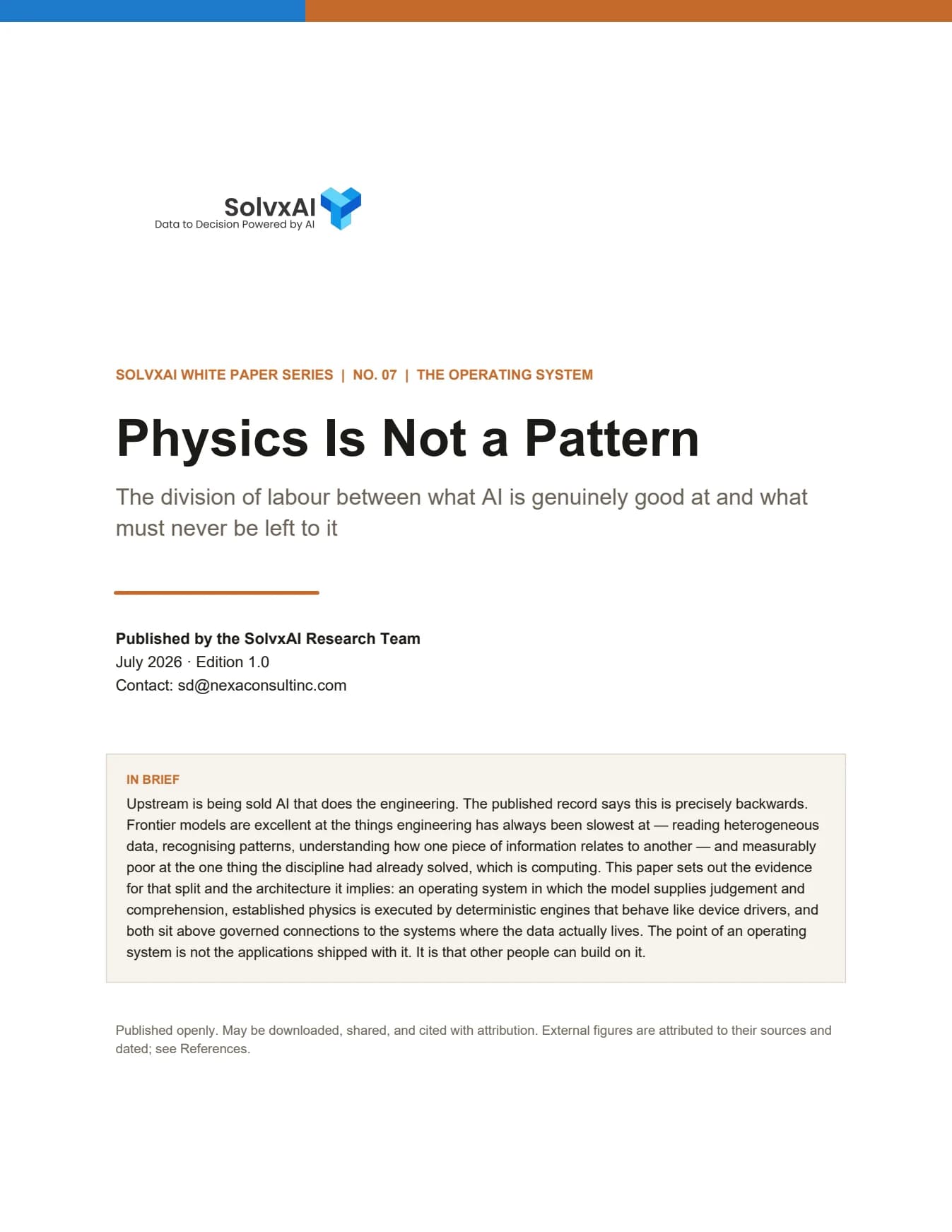 No. 07The operating system
Physics Is Not a Pattern
The division of labour between what AI is genuinely good at and what must never be left to it — and the operating system that follows from it.
Read it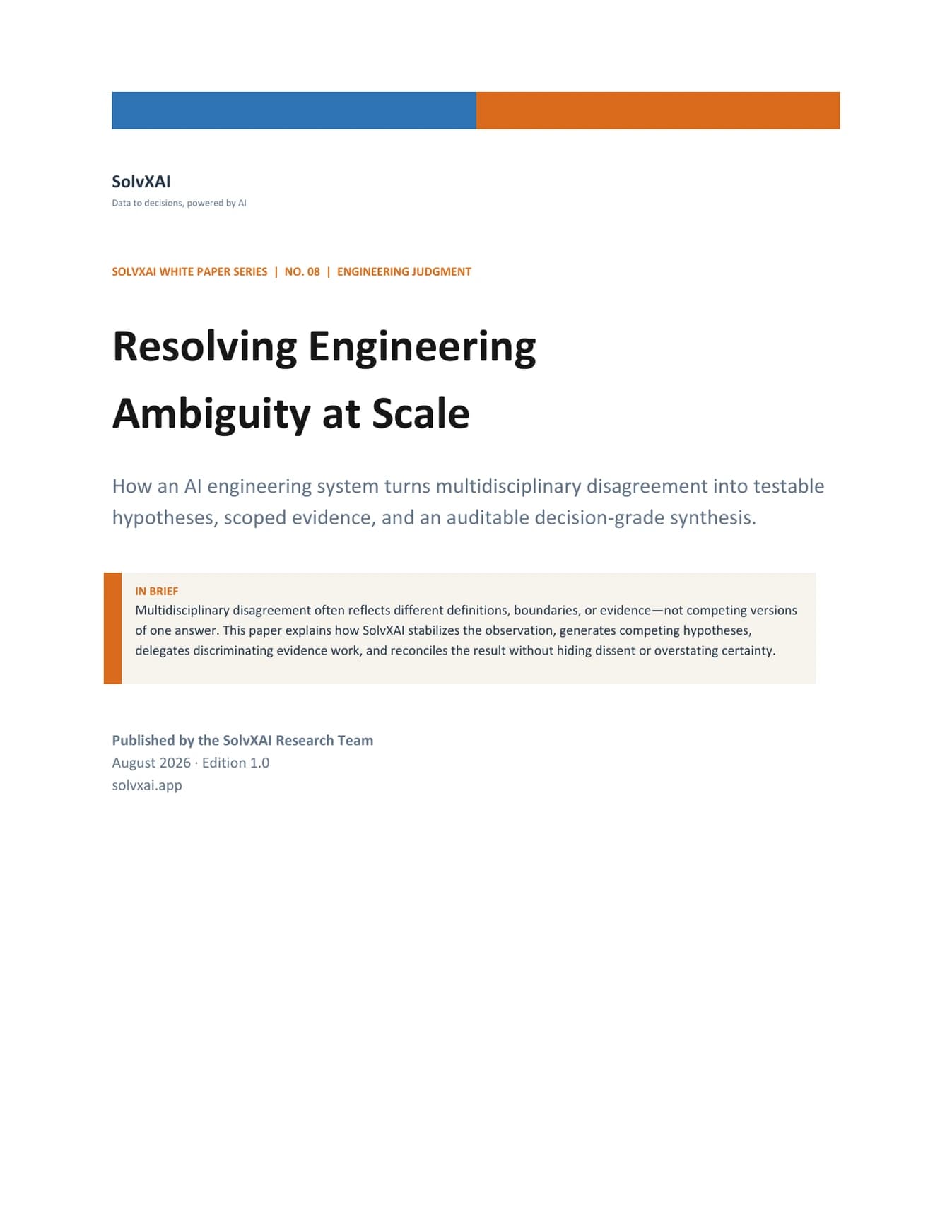 No. 08Engineering judgment
Resolving Engineering Ambiguity at Scale
How an AI engineering system turns multidisciplinary disagreement into testable hypotheses, scoped evidence, and an auditable decision-grade synthesis.
Read it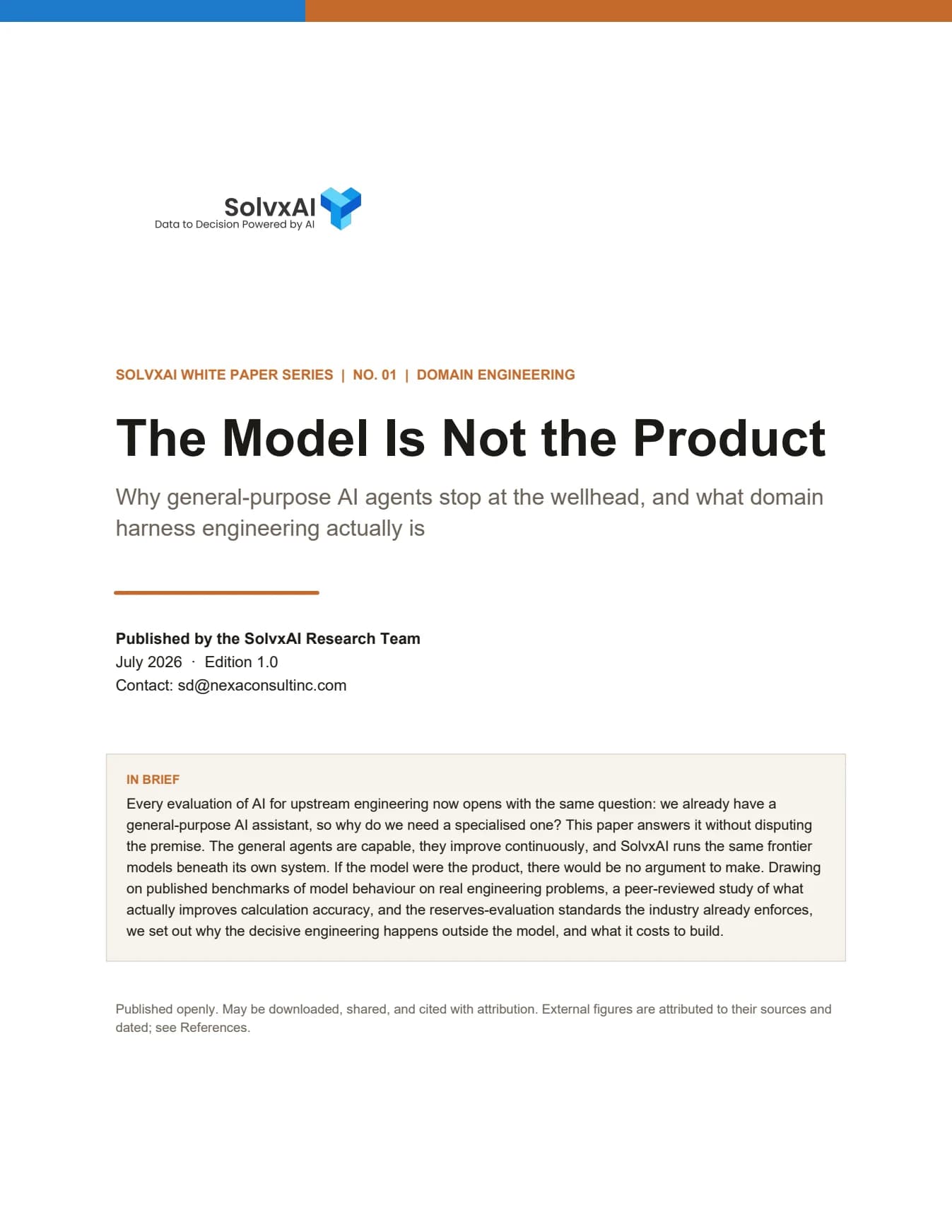 No. 01Domain engineering
The Model Is Not the Product
Why general-purpose AI agents stop at the wellhead, and what domain harness engineering actually is.
Read it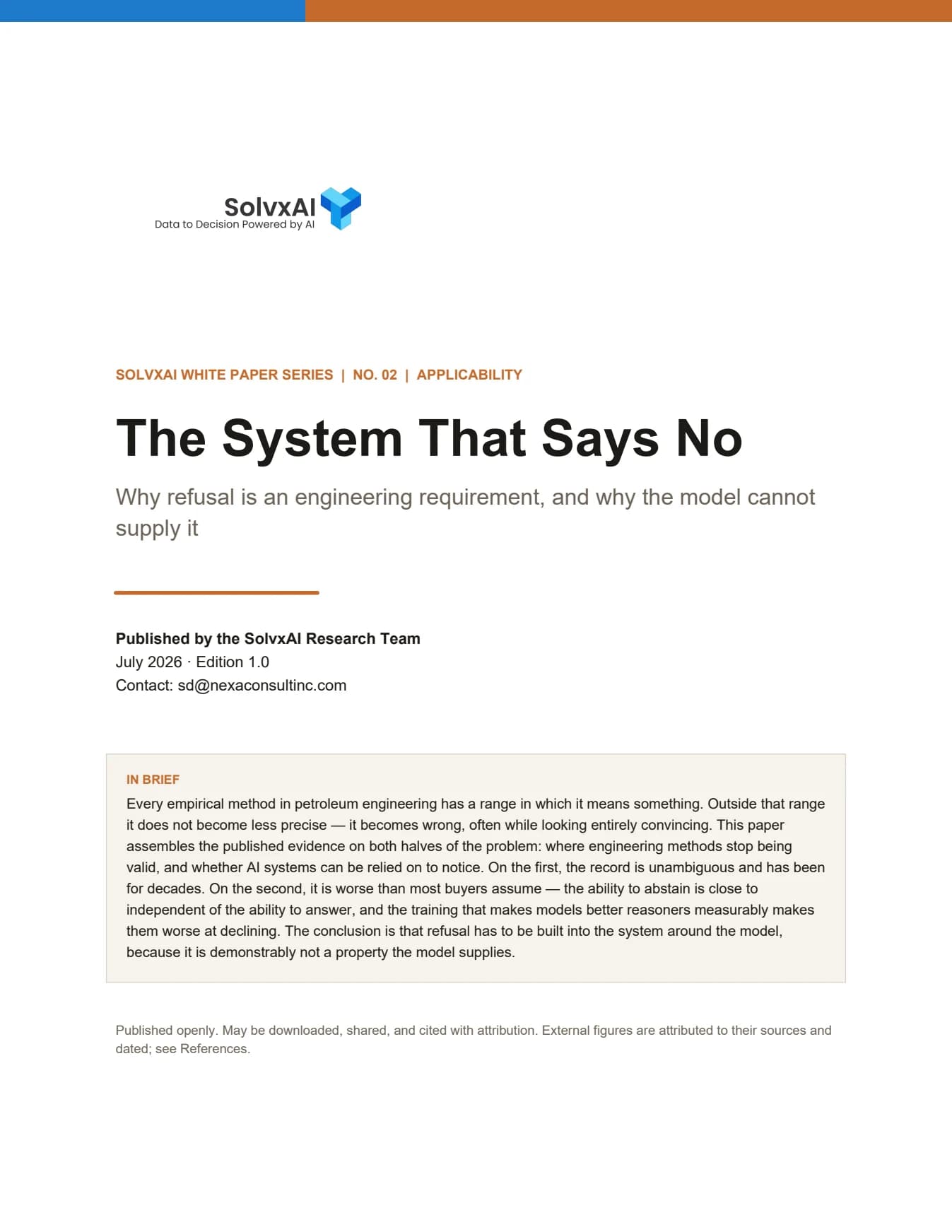 No. 02Applicability
The System That Says No
Every empirical method has a range in which it means something. Why refusal is an engineering requirement, and why the model cannot supply it.
Read it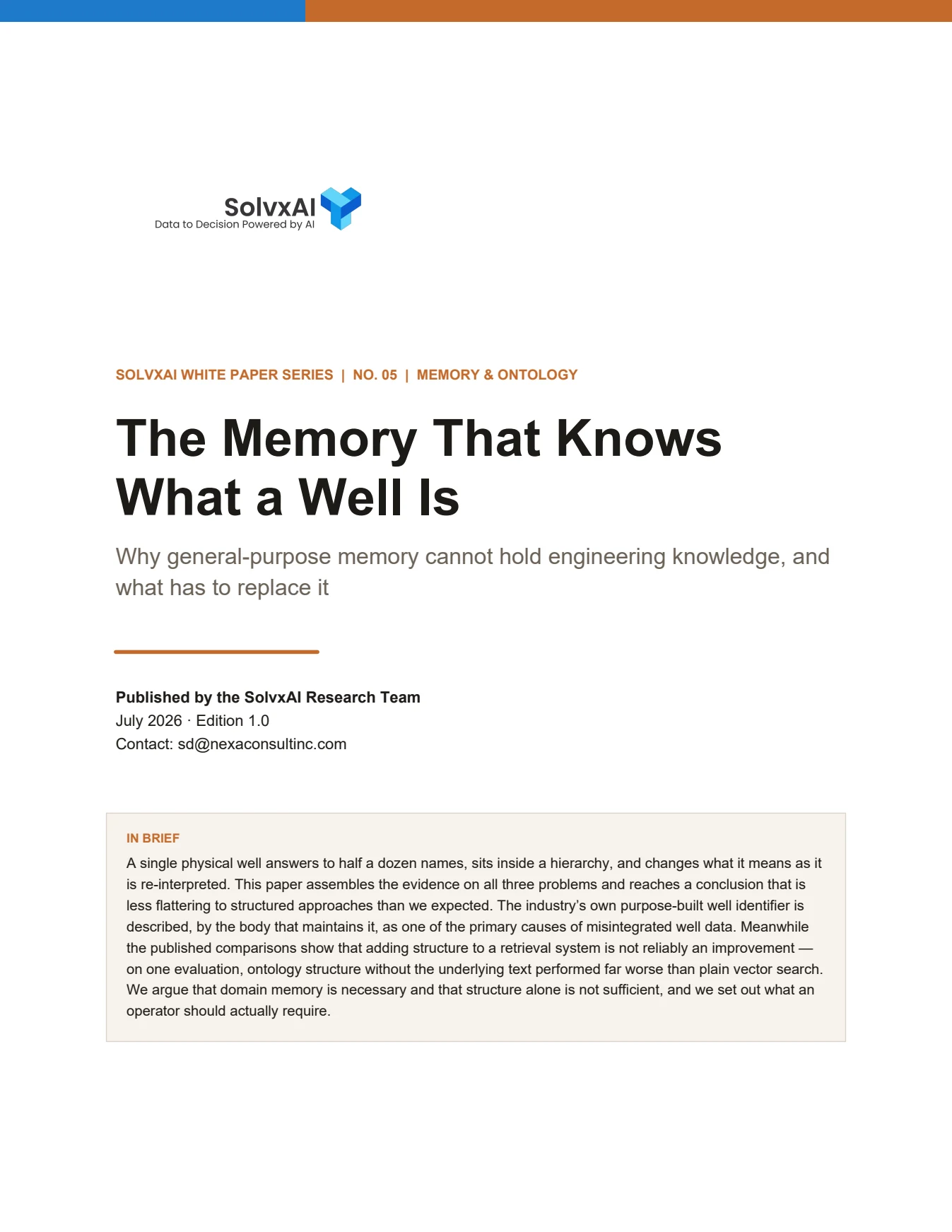 No. 05Memory & ontology
The Memory That Knows What a Well Is
A well answers to half a dozen names, sits inside a hierarchy, and changes what it means over time. Why general-purpose memory cannot hold engineering knowledge, and what has to replace it.
Read it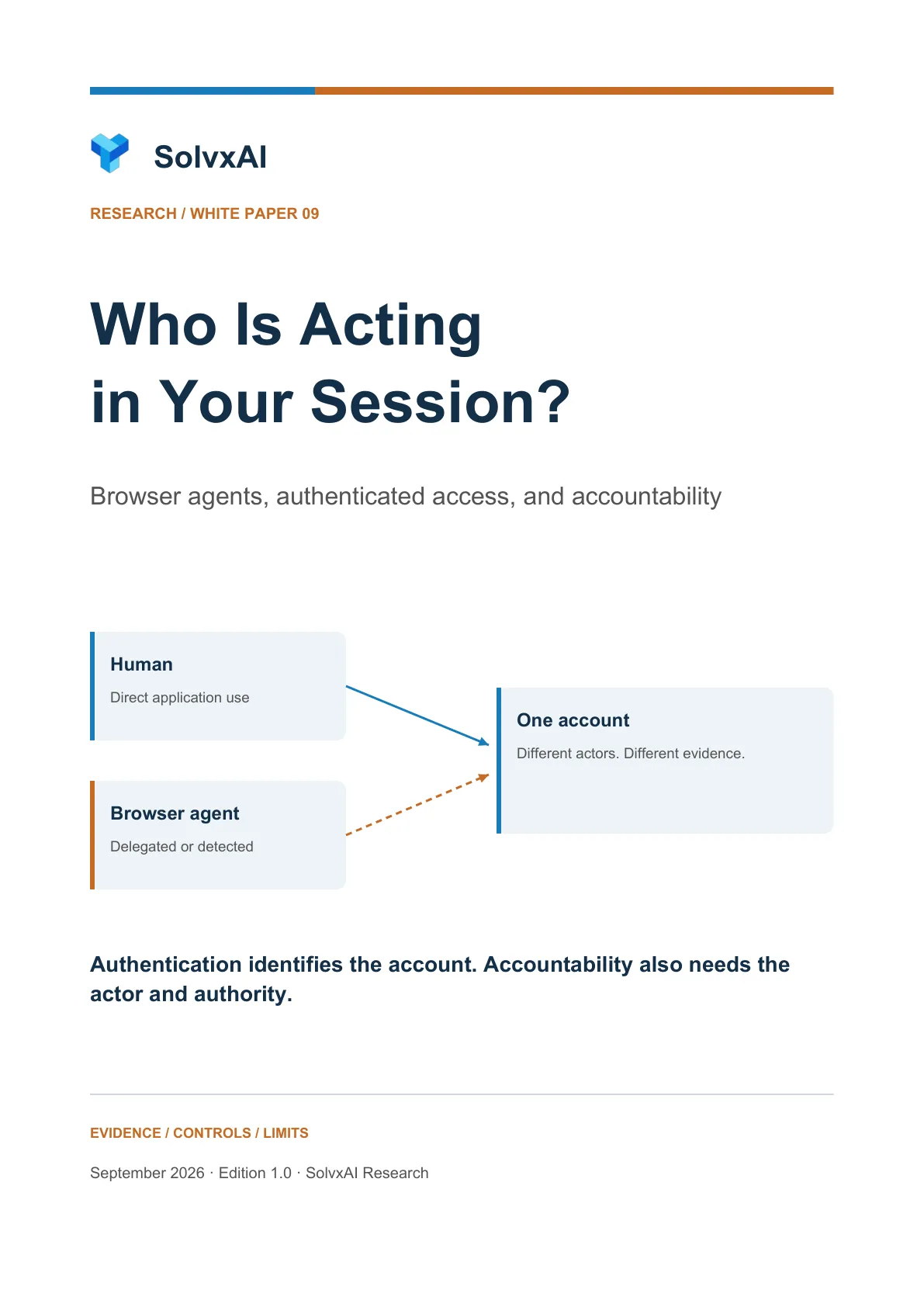 No. 09Agent security & accountability
Who Is Acting in Your Session?
The evidence on automated access through authenticated browsers, the limits of session attribution, and how SolvxAI combines an external-agent guard with monitored, governed use.
Read it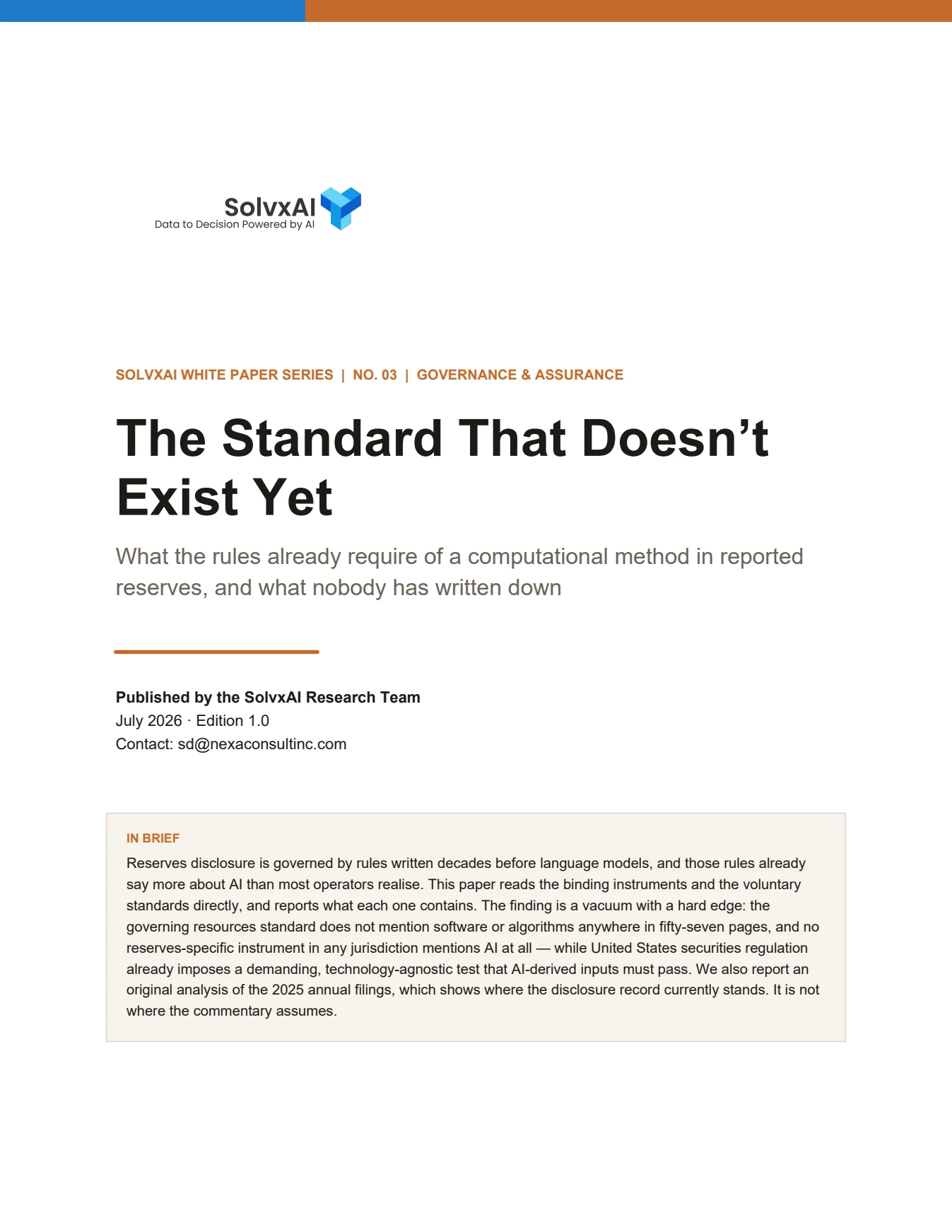 No. 03Governance
The Standard That Doesn’t Exist Yet
Reserves disclosure has rules for reliable technology written decades before language models. What they already require, and what nobody has written down.
Read it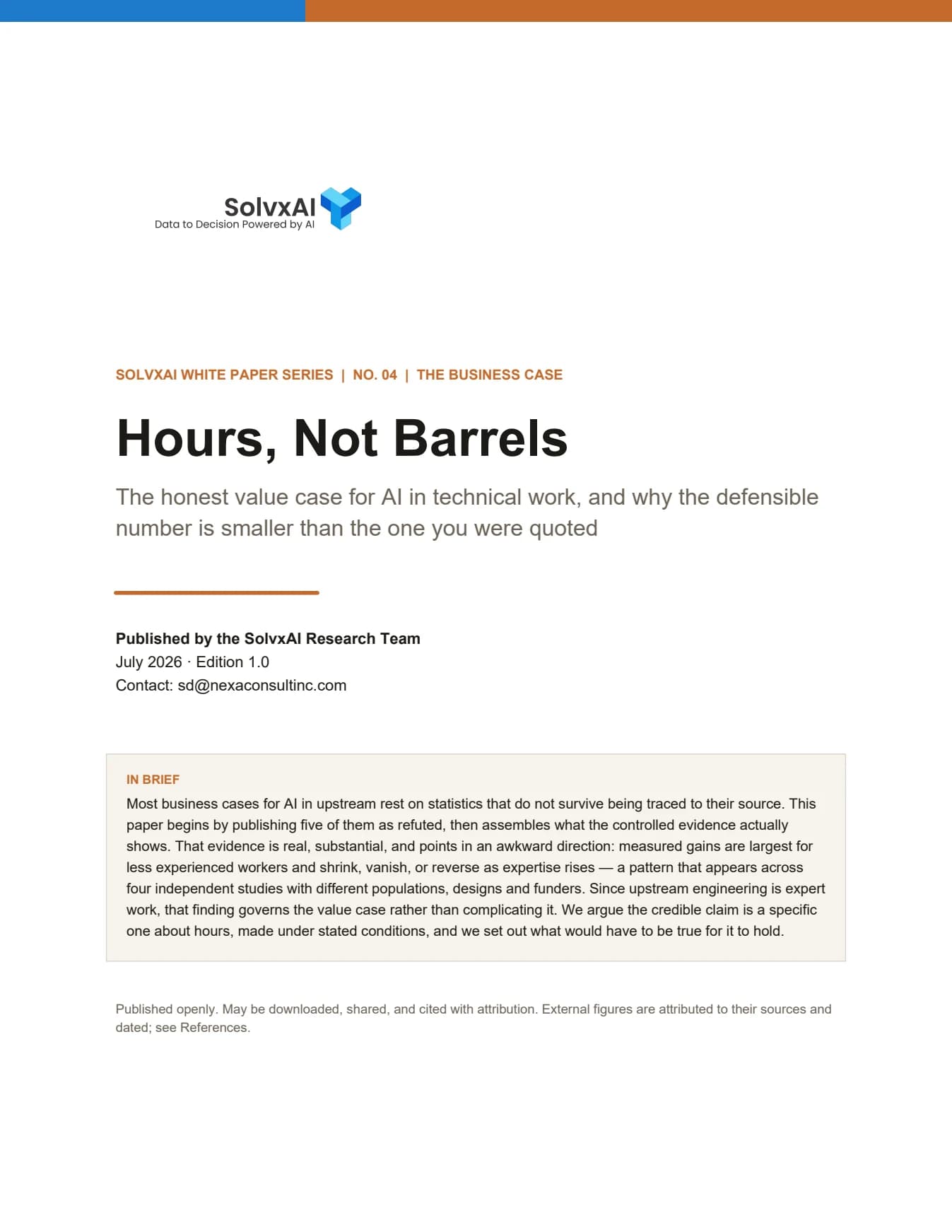 No. 04Value
Hours, Not Barrels
The honest value case. What AI in technical work is measurably worth, what it is not, and why the credible number is smaller and better defended than the one you were quoted.
Read it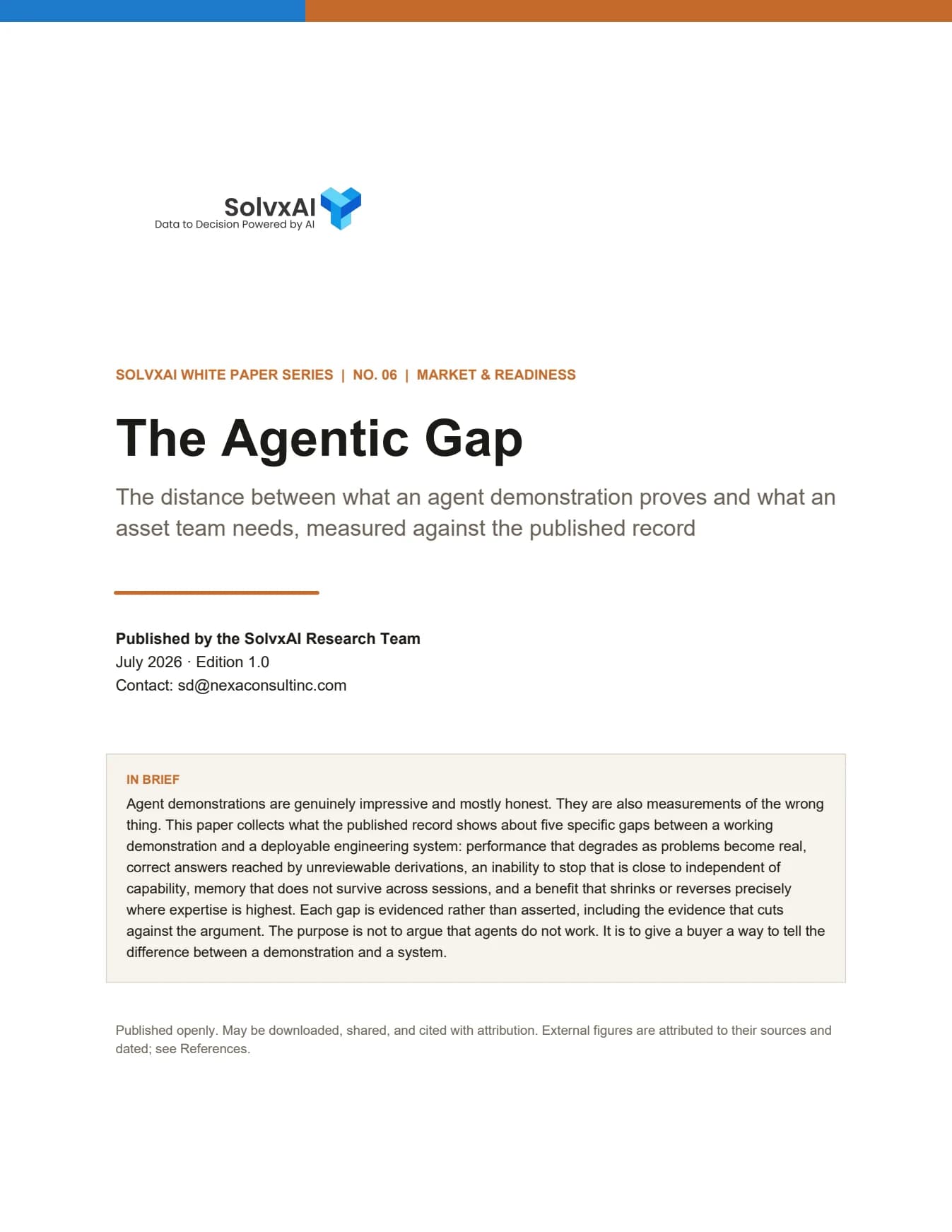 No. 06Market
The Agentic Gap
The distance between what an agent demonstration proves and what an asset team needs, measured against the published record.
Read it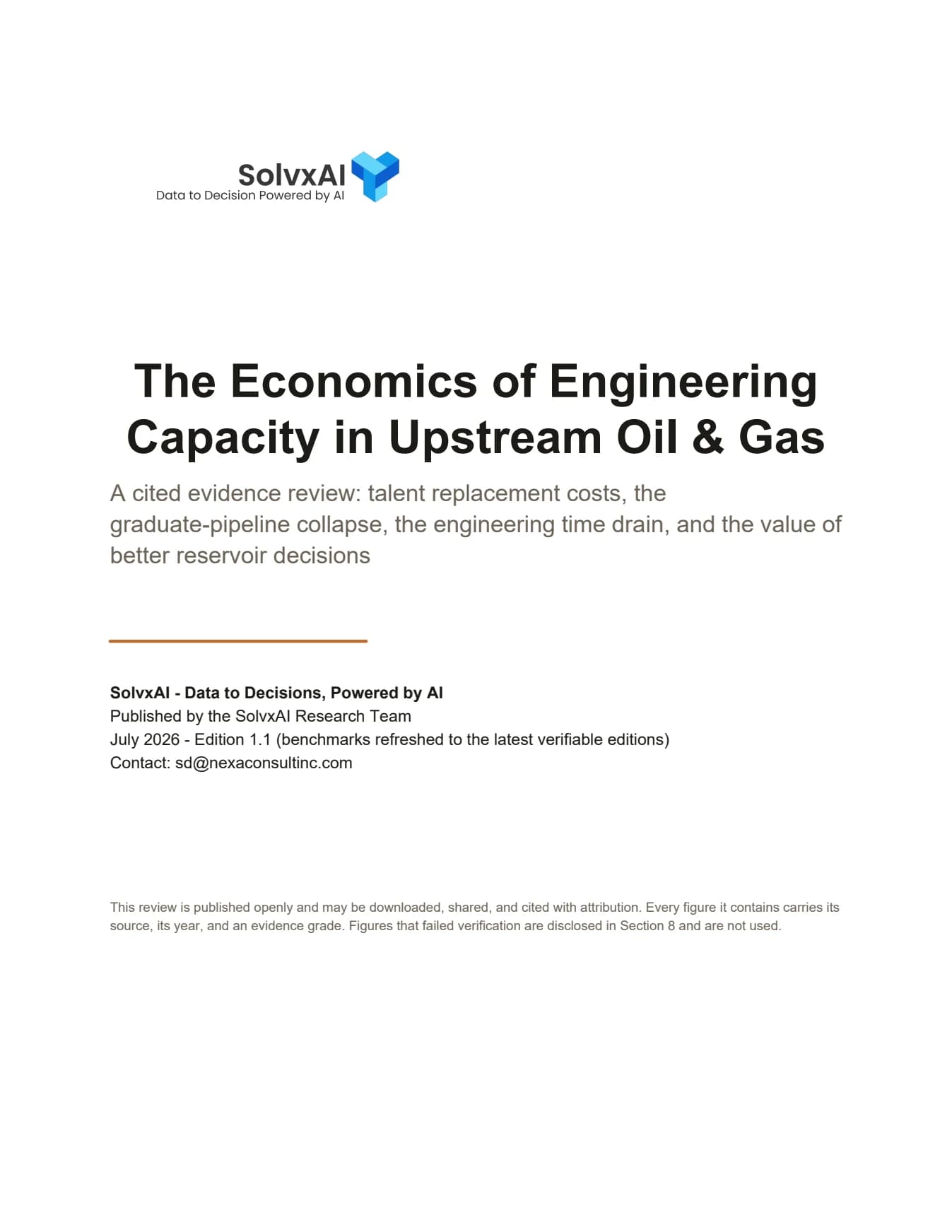 Evidence review
The Cost of the Crew Change
A graded review of the published evidence on technical hiring, replacement cost, and the value of experience leaving the industry.
Read it
The library.
Grouped by the question each set of papers answers. Every published paper can be read in full here before you decide whether to download it.
The operating system
What the model should do, what it must never be asked to do, and the architecture that follows — judgement above, deterministic physics below, governed connections to the systems of record beneath both.
Domain engineering
What has to be true of a system before an engineering answer from it can be defended. These are the papers that argue the platform's premise.
Resolving Engineering Ambiguity at Scale
How an AI engineering system turns multidisciplinary disagreement into testable hypotheses, scoped evidence, and an auditable decision-grade synthesis.
Read it here· 18 pagesPublishedEngineering judgmentThe Model Is Not the Product
Why general-purpose AI agents stop at the wellhead, and what domain harness engineering actually is.
Read it here· 13 pagesPublishedDomain engineeringThe System That Says No
Every empirical method has a range in which it means something. Why refusal is an engineering requirement, and why the model cannot supply it.
Read it here· 14 pagesPublishedApplicabilityThe Memory That Knows What a Well Is
A well answers to half a dozen names, sits inside a hierarchy, and changes what it means over time. Why general-purpose memory cannot hold engineering knowledge, and what has to replace it.
Read it here· 12 pagesPublishedMemory & ontology
Governance & assurance
How computational work is authorized, traced, and reviewed — from reserves reporting requirements to the security and accountability of browser agents.
Who Is Acting in Your Session?
The evidence on automated access through authenticated browsers, the limits of session attribution, and how SolvxAI combines an external-agent guard with monitored, governed use.
Read it here· 18 pagesPublishedAgent security & accountabilityThe Standard That Doesn’t Exist Yet
Reserves disclosure has rules for reliable technology written decades before language models. What they already require, and what nobody has written down.
Read it here· 13 pagesPublishedGovernance
The business case
What this is measurably worth, argued from evidence that survives checking — including the evidence that argues against us.
Hours, Not Barrels
The honest value case. What AI in technical work is measurably worth, what it is not, and why the credible number is smaller and better defended than the one you were quoted.
Read it here· 12 pagesPublishedValueThe Agentic Gap
The distance between what an agent demonstration proves and what an asset team needs, measured against the published record.
Read it here· 10 pagesPublishedMarket
Evidence reviews
Standalone reviews of a body of published evidence, graded and dated, including the claims we set out to support and could not.
Shared directly
These go further than we publish openly. We walk through them with teams running an evaluation rather than posting them.
- On requestTechnical
Compounding IP
How the Reservoir Decision Memory is built: the ontology, how one physical thing is recognised across every name it is given, and how knowledge is kept honest as it ages.
- On requestTechnical
The Order of Operations
Why engineering analysis cannot be parallelised naively, and what it takes to honour the sequence the field actually works in.
- On requestTechnical
Divide, Then Converge
How a question is opened out across specialists for breadth, then closed back down into one answer someone can sign.
- On requestWorkflow
From Mandate to Bid
An acquisition screen from first data room to a defensible number, and where the hours actually go.
How we cite.
Research you can check is the only kind worth publishing.
Everything below is applied to our own claims first.
Verified, not remembered
Every external source is opened and read before it is cited. A reference we cannot retrieve does not appear.
Graded, not levelled
Peer-reviewed work, official standards, and primary data are marked as such — and separated from preprints, industry surveys, and vendor-authored material.
Dated, always
Every figure carries its publication year. Benchmarks move quickly, and a number without a date is not evidence.
Refutations published
Claims we set out to support and could not are printed as refuted rather than quietly dropped. Several widely-repeated industry statistics did not survive.
The technical papers are shared directly.
The engineering tier goes further than we publish openly — how knowledge is held, how work is sequenced, decomposed, and reconciled, and the judgement encoded in each. We walk through them with evaluating teams rather than posting them.