The Production Engineering Platform

Five modules. One engineering record. Zero desktops.

Cloud-native bottom-hole pressure, rate-transient analysis, decline & type curves, numerical simulation, and flow-path optimization — versioned, streamed live, and AI-summarized.

Module 01 · Bottom-Hole Pressure

The number every analysis inherits — treated like it matters.

  • Three trusted correlations, engineer-selected — Hagedorn & Brown, Beggs & Brill, and Gray on the same well, on demand
  • Fluid properties recomputed at local pressure and temperature on every iteration, switching correctly across the bubble point
  • Surveillance-grade diagnostics on every run — friction-vs-gravity split, flow-regime map, liquid-loading flag
  • Every change captured: versioned configurations, field-level diffs, and plain-language AI summaries

Desktop-class correlation physics on a horizontally-scaling, collaborative, AI-augmented cloud backend.
Tubing shoeBubble point PbDatumWHPBHPFrictionGravityHagedorn-BrownBeggs-BrillGrayDepth

Module 02 · Rate Transient Analysis

The regime read — automated, scored, and screened at asset scale.

  • A unified 12-configuration model library — vertical and horizontal, fractured and unfractured, single and dual porosity
  • Automatic, confidence-scored flow-regime detection that enforces physical temporal ordering
  • Screen up to 500 wells in one batch, streamed live, with low-confidence wells auto-flagged into a review queue
  • Non-destructive data conditioning — the stored production record is never altered

Matches incumbent model breadth — and automates the regime-picking bottleneck across an entire asset.

Material Balance Timedp/q & DerivativeLinear ½Bilinear ¼Radial 0DCA prior

Module 03 · Decline & Type Curves

Every fit scored, diagnosed, and auditable.

  • A fully-automated fit pipeline that reproduces the decisions an experienced engineer makes — consistently, on every well and phase
  • Automatic refrac detection with a what-if counterfactual: how much did this refrac actually add?
  • Probabilistic P10/P50/P90 type curves with completion clustering
  • Audit-grade confidence banding, so a thousand-well batch sorts itself by what needs an engineer

Review only what needs judgment — the rest arrives fitted, scored, and defensible.

Time (days)RateLinearTransitionBoundaryP90P50P10Cluster ACluster B

Module 04 · Numerical Simulation

Purpose-built for the fractured well — fast enough to live in a browser.

  • Four native engines: oil and gas, single and dual porosity — built in-house, not wrapped
  • Self-gridding around the hydraulic fracture with a rigorous fully-implicit solve
  • True dual-porosity physics that resolves the transient gradient inside the matrix
  • Live timestep streaming — watch the pressure front move as the solver advances

Interactive, browser-delivered simulation for the decisions you make every week — by design, not by compromise.

WellInitial PiNear-well depletionTRP schedule control

Module 05 · Flow Path Optimizer

The best flow configuration — found, ranked, and defended for you.

  • An exhaustive sweep across flow paths, tubing sizes, and operating conditions — not a one-at-a-time exercise
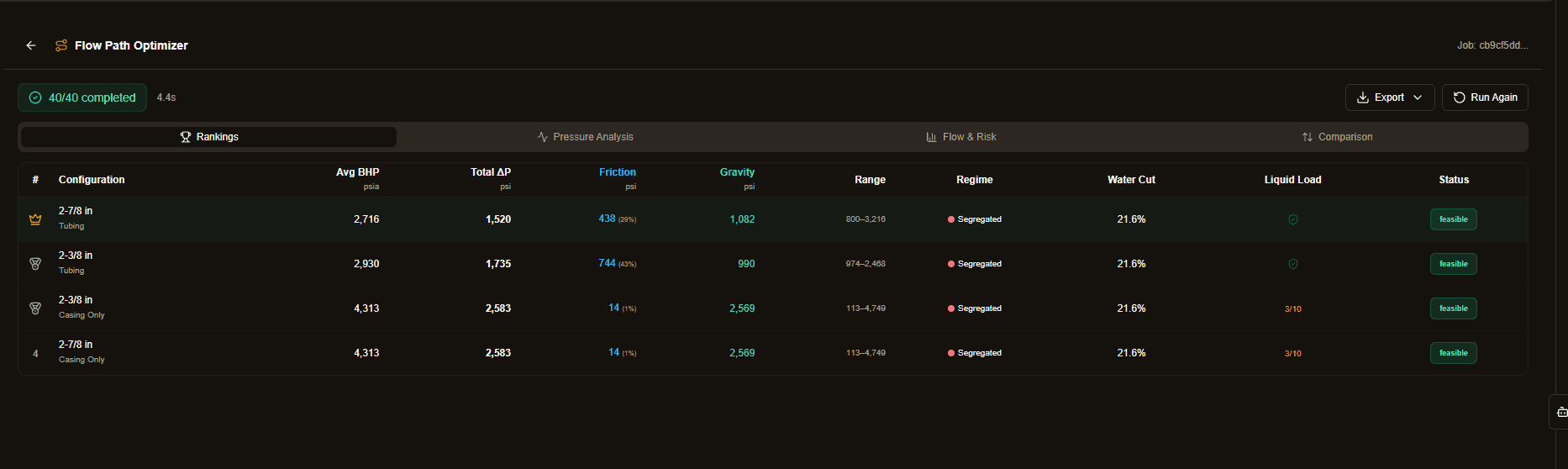
  • Risk-based 0–100 ranking from liquid loading, slug flow, and density inversion, with feasibility verdicts
  • Greenfield design mode or existing-well what-if
  • Built on the same validated pressure engine — one trustworthy core, reused to answer a higher-order design question

Turns a manual screening exercise into an automated, risk-ranked recommendation.

Flow path configurations ranked by operational risk

One connected engineering stack

From surveillance inputs to technical decisions in one product environment.

SolvXAI ties together data conditioning, diagnostics, forecasting, numerical simulation, and collaboration so engineering teams can stay inside one workflow instead of jumping across disconnected tools.

Condition data, then interpret it — in the same workspace

Import production and well data, validate it with AI-assisted mapping, and move directly into analysis without exporting to a separate tool or rebuilding context from scratch.

Shared well and workspace contextAI-assisted data mapping and validationDirect handoff from import to analysis

Diagnostics, forecasting, simulation, and pressure — together

RTA handles production diagnostics and parameter extraction. DCA handles segmented forecasting and completion clustering. BHP handles wellbore pressure traversal. Simulation handles schedule-constrained numerical response. All in one environment.

RTA for diagnostics and parameter extractionDCA for segmented forecasting and clusteringSimulation for schedule-constrained pressure response

Share results and collaborate without leaving the workflow

Attach analysis outputs to team conversations, generate shareable reports, and use contextual AI guidance — so technical work moves into review and decision cycles, not into forgotten export folders.

SolvxAI collaboration workspaceShareable exports and attached outputsContext-aware AI guidance
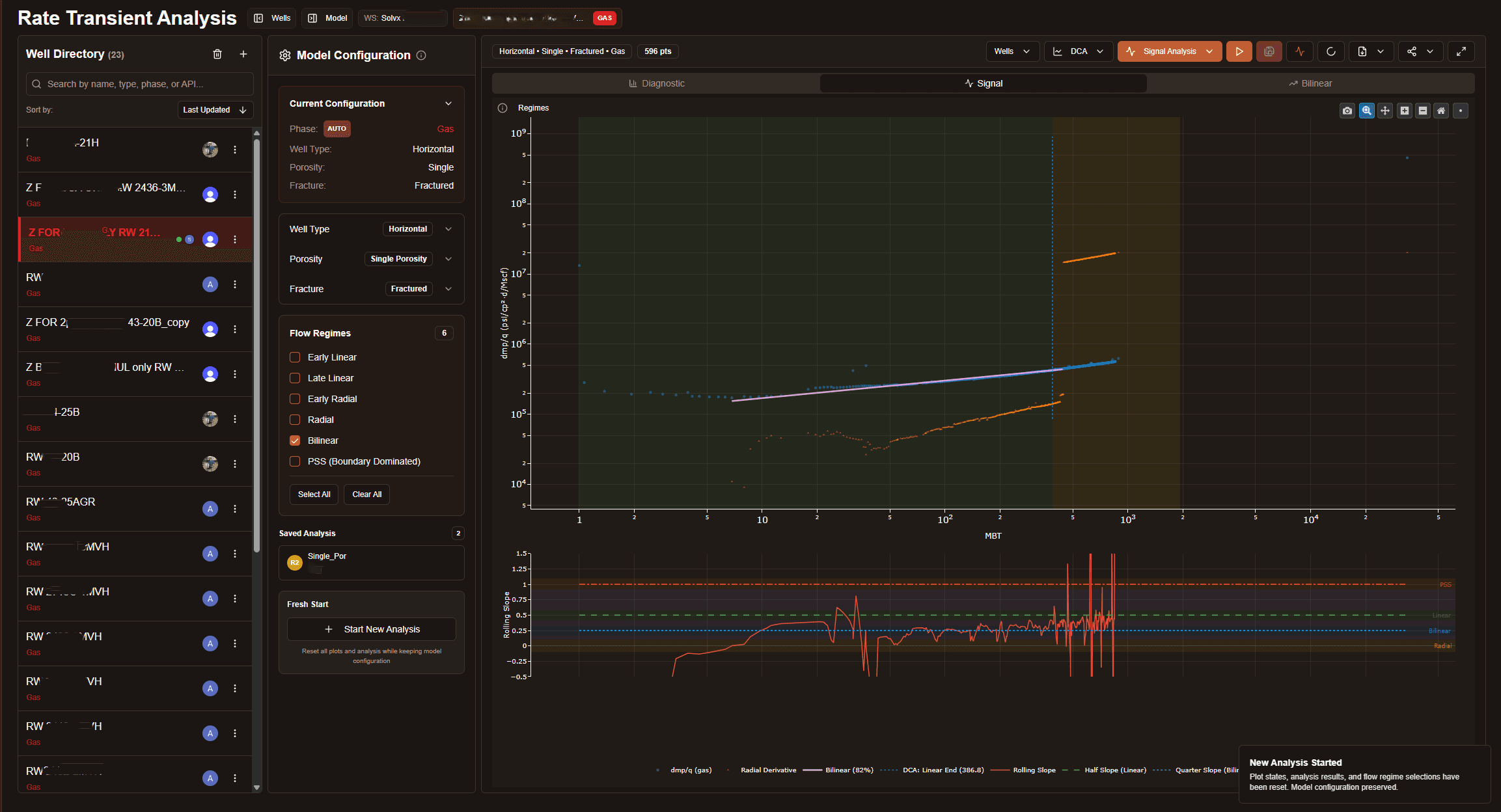
RTA workspace showing signal analysis plot with Bourdet derivatives, MBT axis, and flow regime checkboxes

RTA — Signal analysis with Bourdet derivatives and flow regimes

Well directory, model configuration, signal plot with MBT, and regime identification — all in one analysis surface.

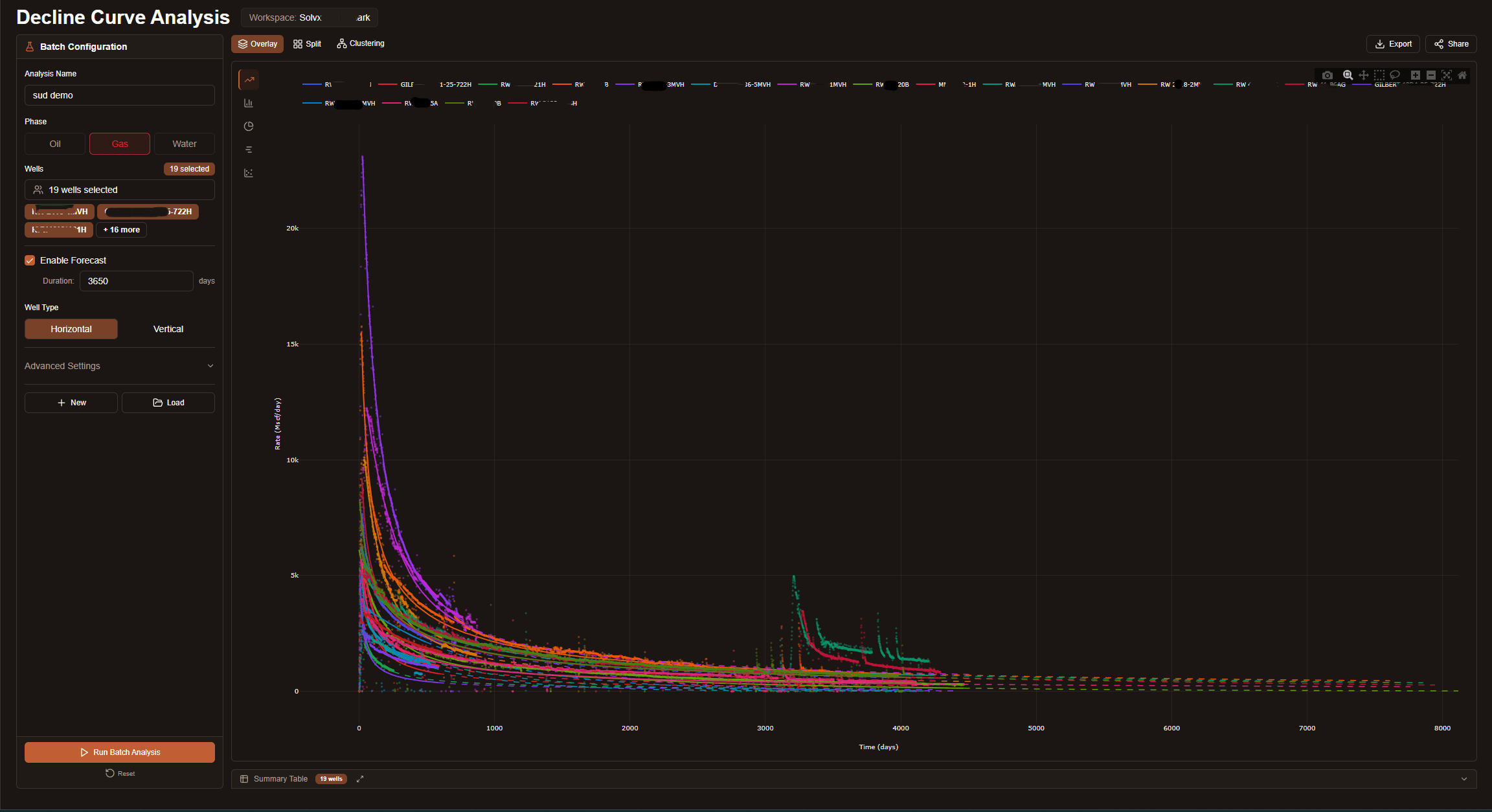
DCA batch overview showing overlaid decline curves for 19 gas wells with production rate on y-axis and time in days on x-axis

DCA — Batch decline overlay for 19 wells

Gas production rate vs. time for a full well population, with batch configuration and forecast controls.

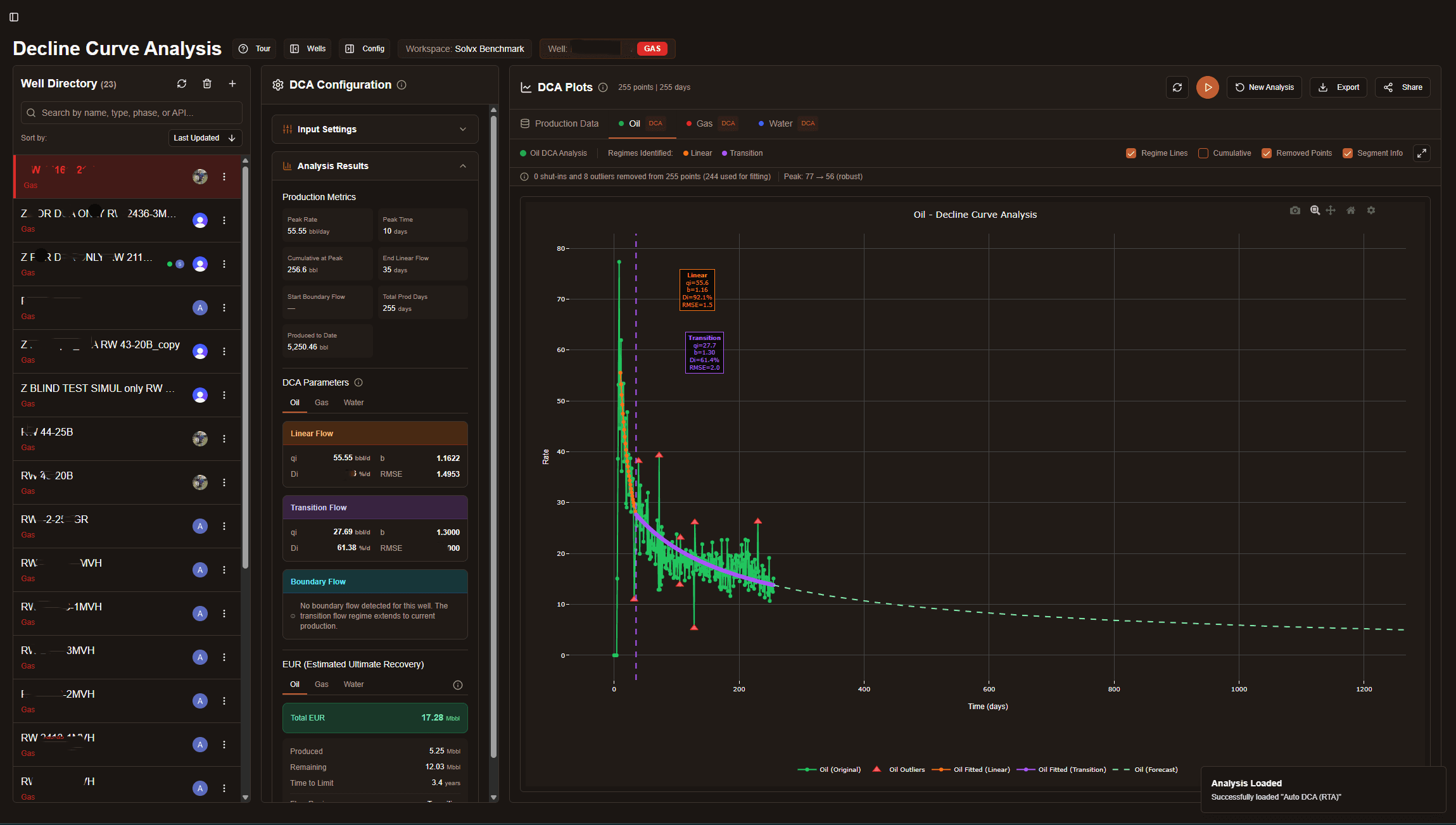
DCA single-well detail showing segmented decline fit with linear flow, transition flow, boundary flow parameters, and EUR calculation

DCA — Segmented decline with linear, transition, and boundary flow

Single-well decline fit showing regime segments, DCA parameters, EUR breakdown, and fitted forecast curves.

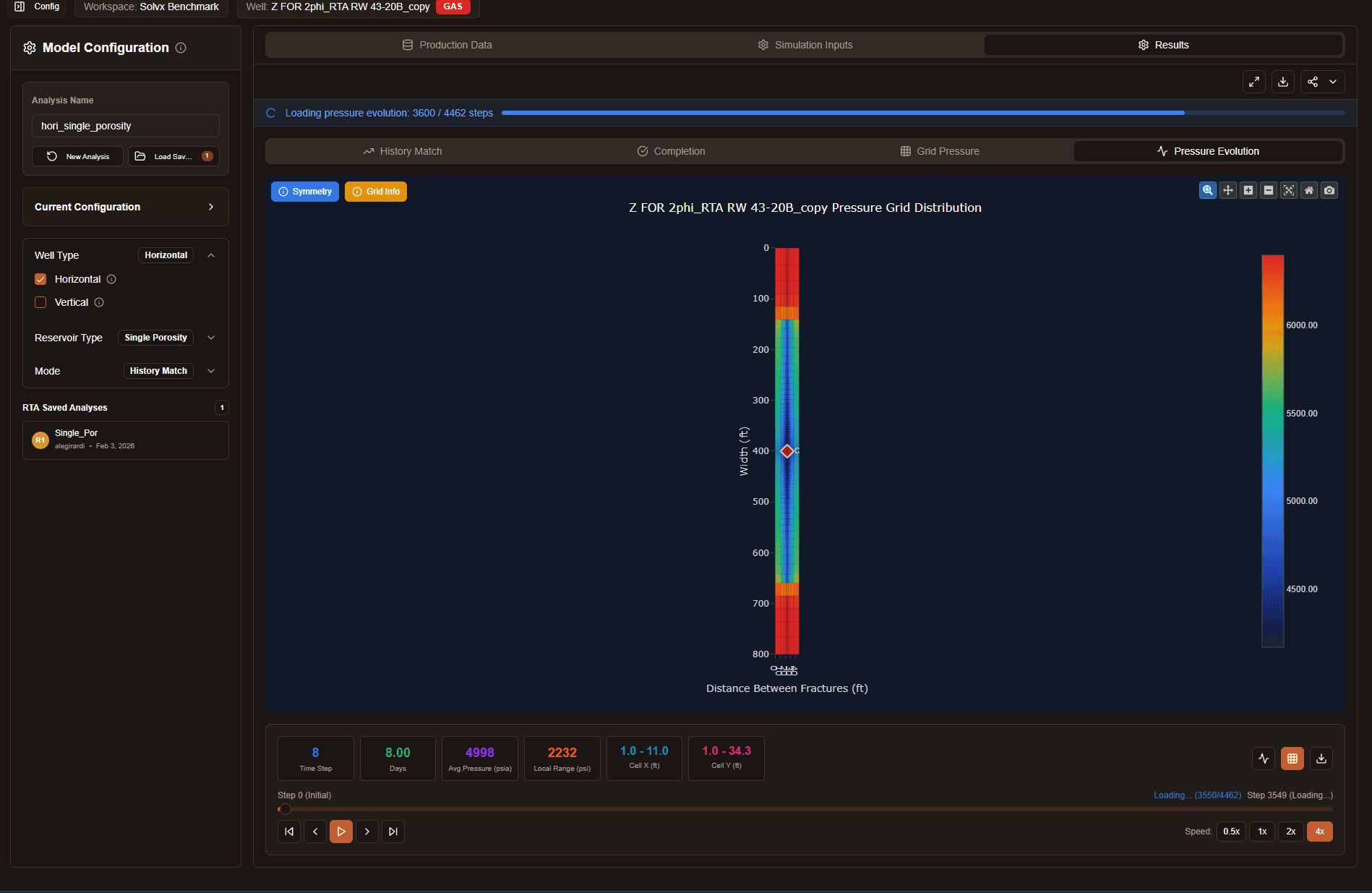
Simulator showing pressure grid distribution heatmap with fracture geometry, progress bar at step 3600 of 4462, and timestep playback controls

Simulator — Pressure grid distribution during history match

Fracture pressure heatmap, live evolution progress, timestep controls, and grid diagnostics for a horizontal single-porosity well.

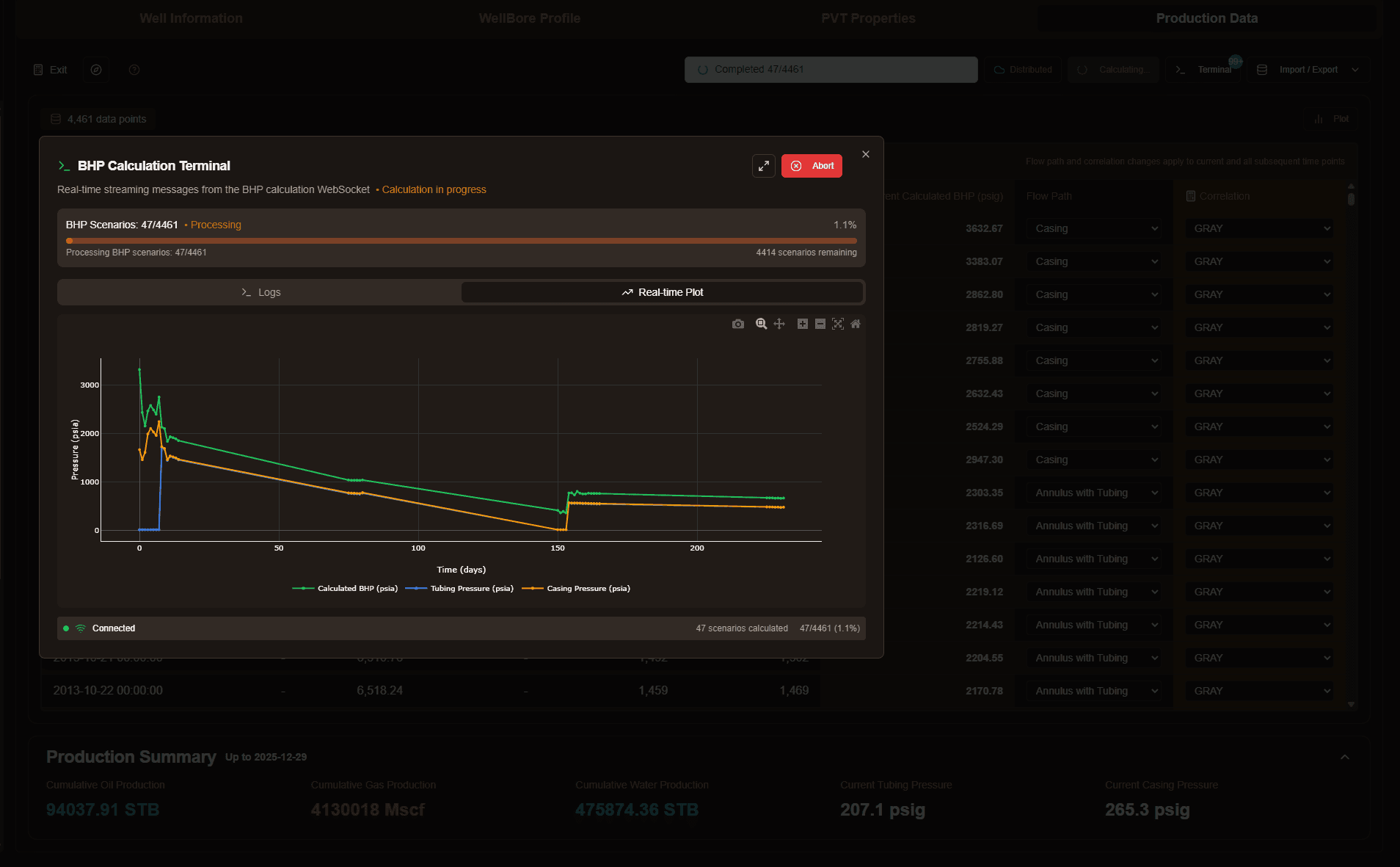
BHP calculation terminal showing 47 of 4461 scenarios processed, real-time pressure chart with calculated BHP, tubing pressure, and casing pressure curves

BHP — Real-time scenario processing with pressure traverse

Streaming calculation terminal running 4,461 BHP scenarios, with calculated BHP vs. tubing and casing pressure plotted in real time.

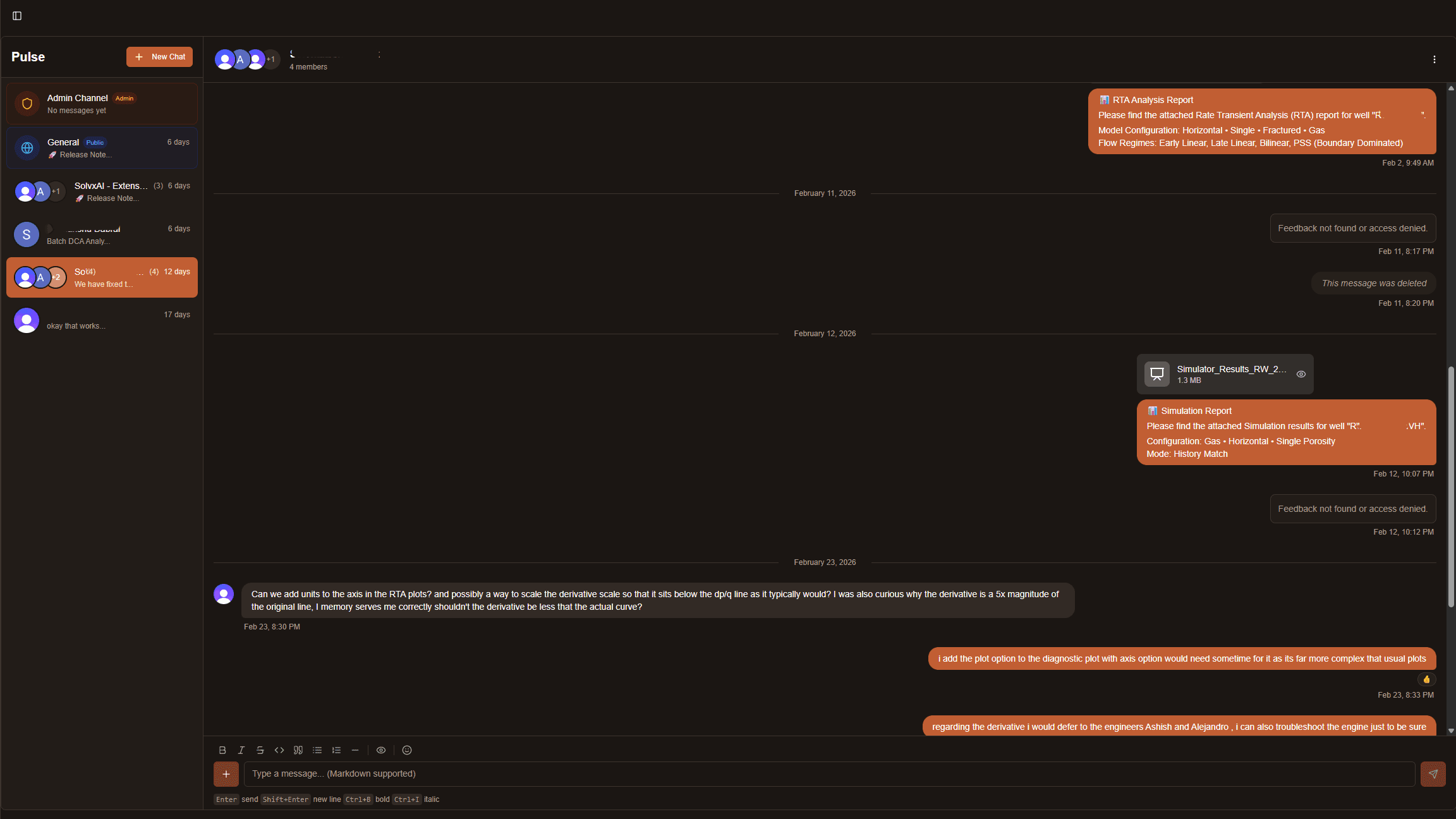
Pulse workspace showing team channels, attached RTA analysis report with model configuration, and simulation results shared in conversation

Pulse — Team discussion with attached analysis reports

Channel-based collaboration with attached RTA and simulation reports, model configuration details, and markdown messaging.

Technical deep dive

Under the hood of every module.

RTA handles production diagnostics and parameter extraction. DCA handles segmented forecasting and completion clustering. BHP handles multiphase wellbore pressure traversal. The simulator handles schedule-constrained numerical reservoir response. And Pulse connects analysis outputs to team collaboration and contextual AI guidance.

Material Balance Timedp/q & DerivativeLinear ½Bilinear ¼Radial 0DCA prior

Regime-aware diagnostics and parameter extraction

Rate Transient Analysis

Automated regime identification with DCA-informed priors, non-classical fractional-flow recognition (Acuna-style), and analytical parameter extraction — from production history to permeability, xf, and OOIP/OGIP.

DCA-RTA integrated interpretation

DCA priors bias and stabilize noisy regime boundaries — most tools keep DCA and RTA operationally separate.

Non-classical fractional-flow diagnostics

Flags fracture-network heterogeneity and transitional slopes that don't sit on textbook linear or bilinear targets.

Automated regime engine

Rolling log-log slopes, derivative ratios, temporal-order enforcement, and segment filtering — not manual point picking.

DCA-RTA cross-validationAcuna fractional flowWhittaker-Henderson smoothingMulti-archetype

Where it stands

Incumbent physics. Cloud architecture. An AI layer on top.

Incumbent physics

The same class of correlation and transient physics engineers already trust — model breadth included, shortcuts not.

Cloud architecture

Zero-install, browser-delivered, elastically scaled. A thousand-scenario batch is a request, not a week.

An AI layer no incumbent offers

Analysis-level versioning with plain-language AI summaries — every recalculation captured, attributed, and explained.

Every module is also a capability of the operating system.

The same physics that powers these five modules is what the SolvxAI agentic system computes with — one platform from a single-well check to an asset-scale study.

Next step

See it on your wells.